


 by
by 

/headlines/pictures/2145/original/sitges-copyright-ybridex-angelodemon-3-1787307065.jpg)
Gay Pride Sitges 2025 - LaVilla Float © Angelo Damon / Flickr
Ask anyone who's spent a weekend in Sitges, and they'll tell you the same thing: this is not a town that happens to have a gay following. It's a town built on gay history. Thirty-five minutes south of Barcelona by train, with a year-round population under 30,000, Sitges punches well above its weight as an LGBTQ+ destination, so the obvious question is: why here?
The short answer is that Sitges has been doing this for over a century. The longer answer is more interesting — and it explains why the town feels so different from a Barcelona night out or a Madrid weekend, even though all three cities are proudly, officially gay-friendly.
(For where to actually go once you're there — bars, saunas, beaches, restaurants, and the current Passeig Marítim scene — see our full Sitges Gay Guide. This piece is about how the town got its reputation in the first place.)
It started with painters, not Pride marches
Sitges' identity as a haven for people living outside the mainstream dates back to 1891, when the Catalan painter, poet, and playwright Santiago Rusiñol settled in the town and brought with him a circle of bohemian, queer, and gender-nonconforming friends. That artistic colony gave Sitges an early reputation for tolerance that had nothing to do with sexuality specifically, but everything to do with the town being a place where Barcelona's rules didn't quite apply.
That reputation had staying power. By the mid-20th century, well-off Barcelona families with gay sons had started quietly sending them to Sitges — close enough for weekends, far enough to be discreet — and those sons brought their friends. A small, self-reinforcing community began to take shape decades before anyone would have called it a "gay destination" out loud.
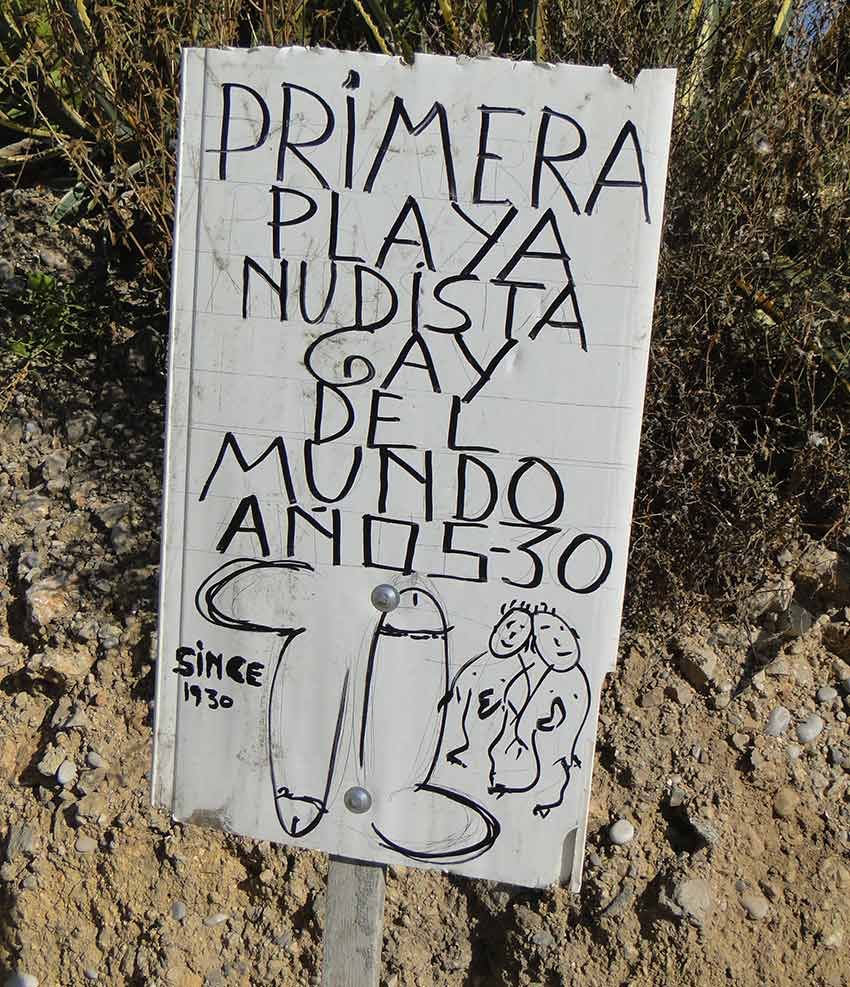
The clearest early marker of that shift predates even those family visits: in 1930, a secluded cove just outside town, Playa del Hombre Muerto, became the world's first gay naturist beach — a title it still carries in local lore today. Tucked behind cliffs and reachable only on foot along the railway tracks, its isolation was less a hindrance than the point: the same seclusion that kept it off the map for casual beachgoers made it one of the only places in pre-war Spain where gay men could be unmistakably, safely themselves.
A refuge during the Franco years
Spain under Francisco Franco's dictatorship (1939–1975) was actively hostile to LGBTQ+ people: homosexuality was criminalized, and gay men were often sent to specific "special danger" prisons under laws targeting so-called social threats. Public displays of affection between same-sex couples could be treated as criminal acts.
Sitges was not exempt from this — Spain's laws applied everywhere — but its distance from Barcelona's more watchful eye, combined with its existing bohemian reputation, made it a place where a discreet gay community could exist more easily than in most of the country. Long-time residents describe those decades as a period of survival through quiet visibility: never open, never safe exactly, but tolerated in a way that few other Spanish towns could offer.
/pictures/data/15063/original/sitges-paseo-maritimo-copyright-martin-silva-cosentino-800-1-1787304404.jpg) Sitges, Paseo Maritimo © Martin Silva Cosentino
Sitges, Paseo Maritimo © Martin Silva Cosentino
Democracy, the Movida, and coming out into daylight
Franco's death in 1975 changed everything, though not overnight. Spain's transition to democracy brought a cultural explosion known as La Movida — a wave of countercultural energy centered in Madrid and Barcelona that reshaped Spanish nightlife, art, and identity through the late 1970s and 1980s. Homosexuality was decriminalized, and gay life in Spain's cities began moving from hidden bars to open streets.
Sitges rode that same wave, but from a head start: it already had the bones of a gay scene, so as Spain opened up, Sitges simply scaled up faster than newer scenes like Madrid's Chueca or Barcelona's own Eixample (nicknamed "Gaixample"). By the late 1990s and 2000s, Sitges had a full gay tourism infrastructure — bars, hotels, and eventually its first formal LGBTQ+ association, founded in 2001. When Spain legalized same-sex marriage in 2005, becoming one of the first countries in the world to do so, Sitges was already a well-established gay resort rather than a scene just getting started.
The Carnival: how a Catholic festival became a Pride statement
If one event explains Sitges' modern identity better than any other, it's Carnival. Held every February, Sitges Carnival predates the modern gay rights movement by decades — it's a traditional pre-Lenten Catholic festival with roots stretching back generations. But over the second half of the 20th century, Sitges' gay community didn't just attend Carnival; they took it over, turning the Rua de la Disbauxa (the "Parade of Debauchery") and the Rua de l'Extravagància into two of the most theatrical, costume-driven LGBTQ+ street events in Europe.
Academic research into Sitges' tourism history describes this as a genuine identity project: Carnival became the mechanism through which the town's gay community moved from a quiet, semi-hidden "pre-gay" period into a confident, globally visible "gay" identity — and later into what researchers call a "post-gay" phase, where the town's queerness is simply assumed rather than something that needs proving. That's a useful way to understand modern Sitges: it isn't performing gay-friendliness for tourists. It's a town that built its own festival culture around being unmistakably, permanently itself.
So, is Sitges the gay capital of Europe?
It's a fair question, and a fair amount of gay press has asked it outright. The honest answer is that "capital" depends on what you're measuring. Mykonos and Gran Canaria have the circuit and party scene; Torremolinos offers a similar small-resort model on Spain's own coast; and Berlin, London, or Amsterdam have the sheer scale of big-city gay life. What Sitges has, that almost nowhere else does, is continuity: over 130 years of an unbroken identity as a place where LGBTQ+ people could be, if not always fully free, at least more themselves than anywhere else nearby. That's a different kind of claim to the title than nightlife alone — and arguably a stronger one.
What does that history mean for a visit today?
None of this is just trivia. It explains why Sitges feels the way it does on the ground: why the Passeig Maritim gay district has the settled, lived-in feel of a genuine neighborhood rather than a strip built for tourists, why the town supports a full-time LGBTQ+ scene rather than just a Pride-week one, and why locals talk about Sitges with a kind of ownership you don't hear in newer gay destinations.
If you're planning the trip itself — where to stay, which beaches are gay, when Pride and Carnival fall this year — that's exactly what our Sitges Gay Guide is built for, alongside gay-hosted stays and gay-friendly hotels in the town itself.
FAQ: Sitges and its gay history
Is Sitges gay-friendly?
Yes — Sitges is one of Europe's most established LGBTQ+ destinations, with a gay history dating back over a century and a full-time gay scene rather than a seasonal one. For current bars, saunas, and safety information, see the Sitges Gay Guide.
Why is Sitges so gay?
Sitges' gay identity dates to 1891, when a bohemian artist community settled there, and deepened through the 20th century as Barcelona families sent gay relatives to the town for privacy. It became a quiet refuge during the Franco dictatorship and expanded rapidly after Spain's democratic transition and the legalization of same-sex marriage in 2005.
Is Sitges a gay town or a gay resort?
Sitges is a real Catalan town of around 30,000 year-round residents, not a purpose-built gay resort. Its LGBTQ+ identity grew organically over more than a century, which is part of why it feels different from newer, purpose-built gay destinations.
Is Sitges the gay capital of Europe?
It's one of the strongest contenders. Sitges doesn't have the biggest nightlife scene in Europe, but it has one of the longest continuous LGBTQ+ histories of any European destination, which gives it a claim other cities can't match on scale alone.
Where is the gay beach in Sitges?
Sitges has several LGBTQ+ beaches, including a well-known naturist option. For the full, up-to-date breakdown by location, see the gay beaches guide for Sitges.


Experience a More Welcoming World
Cozy apartments, private rooms and amazing homes: be welcomed by the gay community in over 200 countries
Apartments, rooms, homes: be welcomed by the gay community


Wherever you're headed, don't forget to add us on Instagram, Facebook and Twitter and share your travel pictures using the hashtag #ExperienceYourPride. We'll share the best pics with our global LGBTQ+ travel community! Share your host story or Local Tips about what to do in your city, and make a video to promote your listing. Interested? Then just email us at stories@misterbandb.com and we'll get back to you.





Advertisement
Where to stay in...
Advertisement
/headlines/pictures/2739/original/costa-brava-misterb-b-1787557713.jpg)
/headlines/pictures/2949/original/cherry-grove-1533120188.jpg)
/headlines/pictures/2939/original/bars-gays-naturistes-paris-1-1787312302.jpg)
/headlines/pictures/4460/original/the-geography-of-gay-desire-1776267445.jpg)
/headlines/pictures/4461/original/brazil-the-new-global-7-for-lgbtq-travel-1776267473.jpg)
/headlines/pictures/3635/original/delice-dream-interview-avec-will-helm-parrain-de-la-5eme-edition.jpg)